
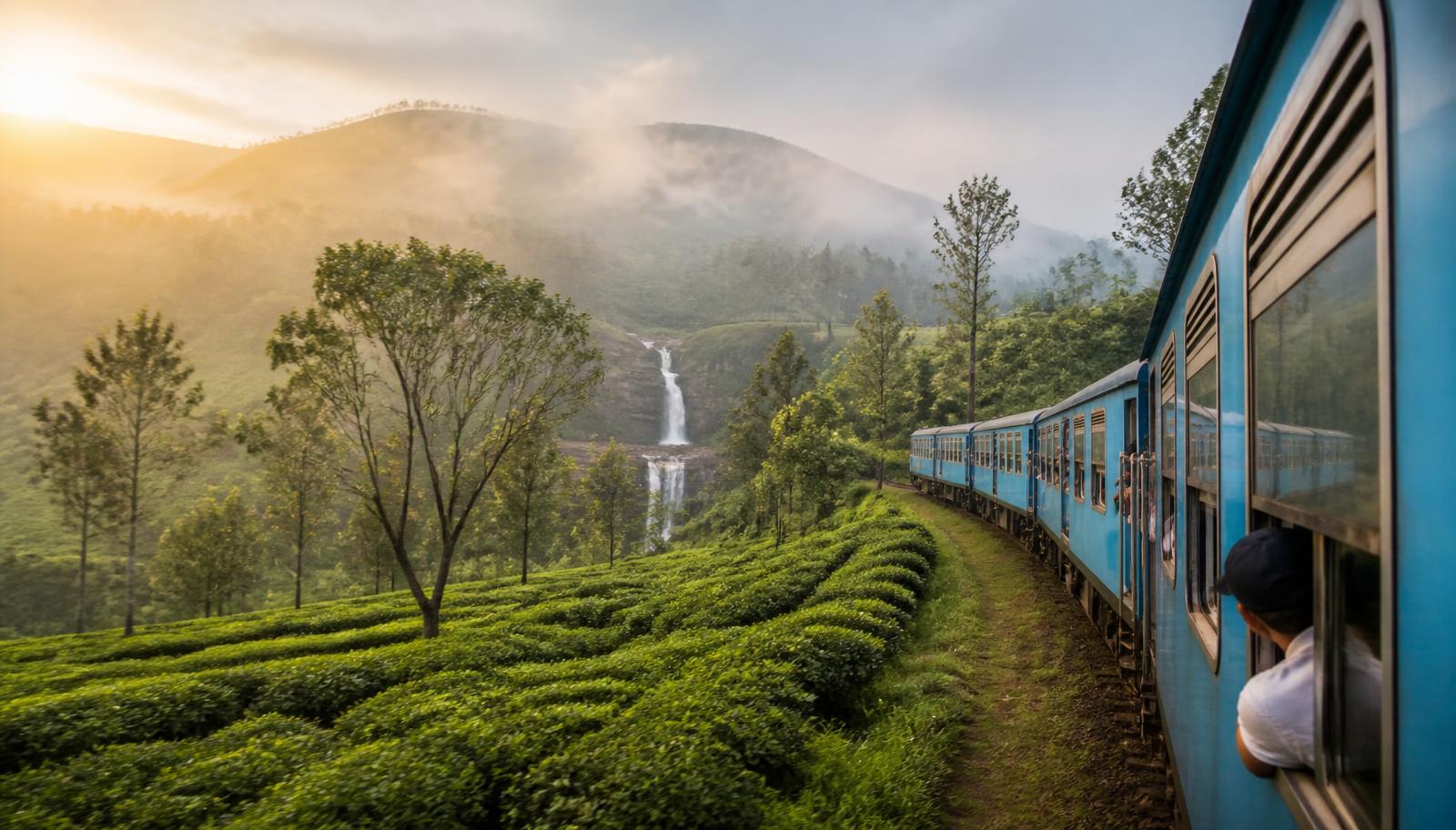
Why This Railway Is Special
The Main Line opened in stages from 1864, when the colonial government needed a way to move coffee — and, after the coffee blight, tea — from the central highlands to the port at Colombo. Engineers pushed the track up escarpments with no tunnelling machinery beyond hand tools and blasting powder, carving switchbacks, viaducts and more than forty tunnels into the mountainside. The final section reached Badulla in 1924.
A century later the same alignment is still in daily use, and it is that survival that makes the ride feel unusual. The carriages are unhurried, the doors stay open, and the line passes through working tea estates rather than around them. Passengers lean out of doorways, vendors move through the aisles selling wade (lentil fritters) and sweet tea, and the train slows to walking pace on the steepest gradients — which is precisely when the views open up.
It is regularly listed among the world’s most scenic railway journeys, and unlike most of that list it remains an ordinary public service: no premium-only tourist train, no fixed departure season, and fares that start at a couple of dollars.
The Route, Section by Section
The full run is Colombo Fort → Kandy (via Peradeniya) → Hatton → Nanu Oya → Pattipola → Haputale → Ella → Badulla. Very few visitors ride all of it in one sitting. Understanding what each section offers helps you choose the leg worth your time.
Colombo Fort to Kandy (121 km, ~3 hours)
Flat, green and busy: paddy fields, coconut plantations, level crossings and small-town platforms. The scenery becomes genuinely interesting only after Rambukkana, where the train tackles the Kadugannawa incline and climbs some 400 metres in about 20 kilometres, curling around Sensation Rock with the lowlands falling away behind. Many travellers skip this leg and drive to Kandy instead, using the time to stop at the Temple of the Tooth and Kandy’s highlights.
Kandy to Hatton (72 km, ~3 hours)
The climb proper. The line rises steadily through forest and the first tea gardens, passing Gampola and Nawalapitiya, the line’s old engineering depot. Hatton is the jumping-off point for Adam’s Peak (Sri Pada), the pilgrimage mountain climbed overnight between December and May — covered in our guide to hiking in Sri Lanka.
Hatton to Nanu Oya (30 km, ~1.5 hours)
Reservoir country. The train skirts the Castlereagh and Kotmale catchments, crosses steel bridges above plunging streams and runs through estates whose names — Somerset, Norwood, St Clair — are a reminder of who laid the track. St Clair’s Falls, once nicknamed the “Little Niagara of Sri Lanka”, is visible from the carriage window shortly after Talawakele. Nanu Oya is the station for Nuwara Eliya, the hill station 8 km uphill.
Nanu Oya to Ella (52 km, ~3 hours)
This is the section people mean when they talk about the Sri Lanka train journey. Between Nanu Oya and Ella the train reaches its summit at Pattipola (1,898 m), slips through the Summit Tunnel and emerges on the drier southern side of the range, where the whole Uva basin appears at once. At Idalgashinna the track runs along a ridge with tea falling away on both sides; at Haputale it clings to a shelf above a 1,000-metre drop; and just before Ella it spirals through the Demodara loop, where the line passes over itself to lose height.
Ella to Badulla (17 km, ~1 hour)
A short, pretty coda most travellers skip, though it does cross the celebrated Nine Arch Bridge at Demodara — a 91-metre stone viaduct built without steel during a wartime shortage, and now the single most photographed structure on the line. If you get off at Ella you can walk to the bridge in about 25 minutes and watch a train cross it instead.
Timetable & Journey Times
Sri Lanka Railways runs several daily services on the Main Line, mixing slow stopping trains with faster intercity expresses. Timings shift a few times a year, so confirm on the day of travel — but the shape of the day rarely changes: the best-known services leave Colombo early morning and Kandy mid-morning, putting you in the highlands in good afternoon light.
| Leg | Distance | Typical time | Worth it? |
|---|---|---|---|
| Colombo Fort → Kandy | 121 km | 3 h | Optional — drive instead |
| Kandy → Nanu Oya | 102 km | 4–4.5 h | Yes, if you have the day |
| Nanu Oya → Ella | 52 km | 3 h | The highlight leg |
| Haputale → Ella | 27 km | 1.5 h | Best short taster |
| Ella → Badulla | 17 km | 1 h | Skippable |
Delays of 30–60 minutes are normal, especially in the afternoon and during the monsoon. Never book a same-day flight out of Colombo on the back of a highland train.
Tickets, Classes & Prices
Fares are startlingly low by international standards — the full Kandy to Ella run costs the price of a coffee in third class and only a few dollars in first. What you are really buying is a seat, and in high season seats are the scarce commodity.
- First class observation saloon — reserved, forward or rear-facing, large windows and a panoramic rear screen on some services. Air-conditioned carriages have sealed windows, which photographers dislike; non-air-conditioned observation cars are the better choice for pictures.
- Second class reserved — the sweet spot. Padded seats, windows that open, access to the doorways, and a fraction of the first-class scramble.
- Second and third class unreserved — sold on the day, no seat guarantee. Standing for three hours is common in peak months, but the atmosphere is unbeatable and the doorway views are the same.
Reserved tickets open 30 days ahead and the Kandy–Ella legs frequently sell out within hours between December and March and again in July and August. Book at a station counter, through the official online reservation service, or ask us to arrange it as part of your trip. Keep your ticket until you leave the destination station — it is checked at the exit.
Best Seats & Which Side to Sit
Travelling uphill towards Ella, the right-hand side generally gives the deeper valley panoramas — the Uva basin, the drop below Haputale, the long views towards the south coast on a clear day. The left-hand side is better for tea pluckers at arm’s length, estate factories and the run-in to the Nine Arch Bridge. In practice the line curves constantly, so both sides get their moments.
- Rear-facing seats in an observation car give an uninterrupted view of the track unspooling behind you.
- Doorway spots are first-come, first-served; be polite about taking turns and never hang out on a curve.
- Avoid seats directly beside the toilet vestibule on long legs.
- Light is best in the morning heading east; afternoon services often meet cloud above 1,500 m.
Where to Break the Journey
Riding the whole line in one day is possible but wasteful. The highlands are the best part of Sri Lanka for slow travel, and every major station has something worth a night.
- Kandy — the Temple of the Sacred Tooth Relic, the lake, the botanical gardens at Peradeniya and an evening Kandyan dance show. See our 4-day Kandy and hill country tour.
- Hatton — base for Adam’s Peak and the Castlereagh reservoir tea bungalows.
- Nuwara Eliya (from Nanu Oya) — colonial-era hill station, Pedro tea factory, Horton Plains and World’s End at dawn.
- Haputale — Lipton’s Seat at sunrise, arguably the finest viewpoint in the tea country and far quieter than Ella.
- Ella — Little Adam’s Peak, Ella Rock, Ravana Falls and the Nine Arch Bridge; the most touristed town on the line, and still worth two nights.
From Ella most itineraries drop south towards Yala or Udawalawe for safari — we compare the two parks in Yala vs Udawalawe — and then on to the south coast beaches.
Best Time of Year to Ride
The hill country has its own weather, independent of the coastal monsoons. January to March brings the clearest mornings and cold nights; April to September is greener but the south-west monsoon can wrap the ridges in cloud, particularly around Hatton and Nuwara Eliya; October and November are the wettest and least reliable for views.
Whatever the month, take an early service. Cloud builds through the day above 1,500 metres, and a 7 a.m. departure regularly sees blue sky where a 2 p.m. departure sees white. For a full month-by-month picture read our best time to visit Sri Lanka guide.
What to Bring on Board
- A warm layer. Pattipola can sit near 10 °C with the windows open, even when Colombo is at 32 °C.
- Water and snacks, though vendors board at most stations with tea, fritters and mango with chilli salt.
- Cash in small notes for vendors and porters; card acceptance on board is nil.
- A daypack, not a suitcase. Luggage racks are small and vestibules crowd quickly.
- A power bank — sockets are unreliable and you will use the camera more than you expect.
- Motion-sickness tablets if you are sensitive; the switchbacks above Hatton are continuous.
Our full Sri Lanka packing list covers the rest of the trip.
Safety & Etiquette
The open doorways are part of the appeal and part of the risk. Injuries happen every year, almost always to people leaning far out on curves or sitting on the footplate with legs outside. Hold the handrail with both hands, keep your body inside the door frame on bends, and never step down while the train is moving. Selfie sticks and phones are frequently lost to passing vegetation.
On the Nine Arch Bridge, walk the trackbed only when no service is due — local guides know the timings — and step well clear onto a buttress if one approaches. Inside the carriage, offer reserved seats to elderly passengers, keep music on headphones, and ask before photographing people. Tea estate workers are at work, not on display.
How to Combine the Train With a Private Tour
The awkward part of a Sri Lanka train journey is everything either side of it: getting to the station, managing luggage, and reaching a hotel that is often 8–20 km from the platform. The simplest fix is to ride the scenic leg and have a private driver handle the rest. On our private Sri Lanka tour packages the driver-guide drops you at the departure station with a daypack, drives your luggage over the mountains, and is waiting on the arrival platform — so a missed or delayed service never derails the day.
Two itineraries build the ride in naturally:
- 7-day private tour with driver — cultural triangle, Kandy, the tea country train leg and a safari.
- 10-day hill country & cultural triangle tour — adds Horton Plains, Lipton’s Seat and two nights in Ella.
If you would rather price a trip yourself first, use our Sri Lanka trip cost calculator or read how much a Sri Lanka trip costs in 2026.
Frequently Asked Questions
How long is the Sri Lanka train journey from Colombo to Ella?
Colombo Fort to Ella is roughly 275 km on the Main Line and takes about 9 to 10 hours. Most travellers ride only the highland section — Kandy to Ella (about 6 to 7 hours) or the shorter Nanu Oya/Nuwara Eliya to Ella leg (about 3 hours), which contains the best scenery.
Which is the most scenic part of the Sri Lanka train ride?
The stretch between Nanu Oya (for Nuwara Eliya) and Ella is the most photographed: tea estates, waterfalls, misty ridges, Idalgashinna’s knife-edge views and the Demodara loop just before Ella.
How do I book Sri Lanka train tickets?
Reserved seats in first and second class open 30 days in advance and sell out quickly in high season. You can book at any station counter, through Sri Lanka Railways’ online reservation service, or through an agent. Unreserved second and third class tickets are sold on the day at the station.
Which side of the train has the best views?
Travelling uphill from Kandy towards Ella, the right-hand side generally has the wider valley views, while the left side is better for tea-estate close-ups and the Nine Arch Bridge approach. In an observation car the rear window gives the best photographs.
Is the Sri Lanka train journey worth it with children or older travellers?
Yes, if you keep the leg short. A 2 to 3 hour reserved-seat ride such as Nanu Oya to Ella or Ella to Haputale gives the same scenery without a full day on board, and a private driver can meet you at the arrival station with your luggage.
Can I do the train ride as part of a private tour?
That is the most comfortable way to do it. Your driver-guide drops you at the departure station, carries the luggage by road and meets you at the arrival platform, so you ride the scenic section unencumbered and keep full flexibility for the rest of the day.
Plan Your Ride
We book the reserved seats, time the leg for the best light and handle the logistics either side. Tell us your dates and we will suggest the right section for your itinerary — get in touch or design your trip.